

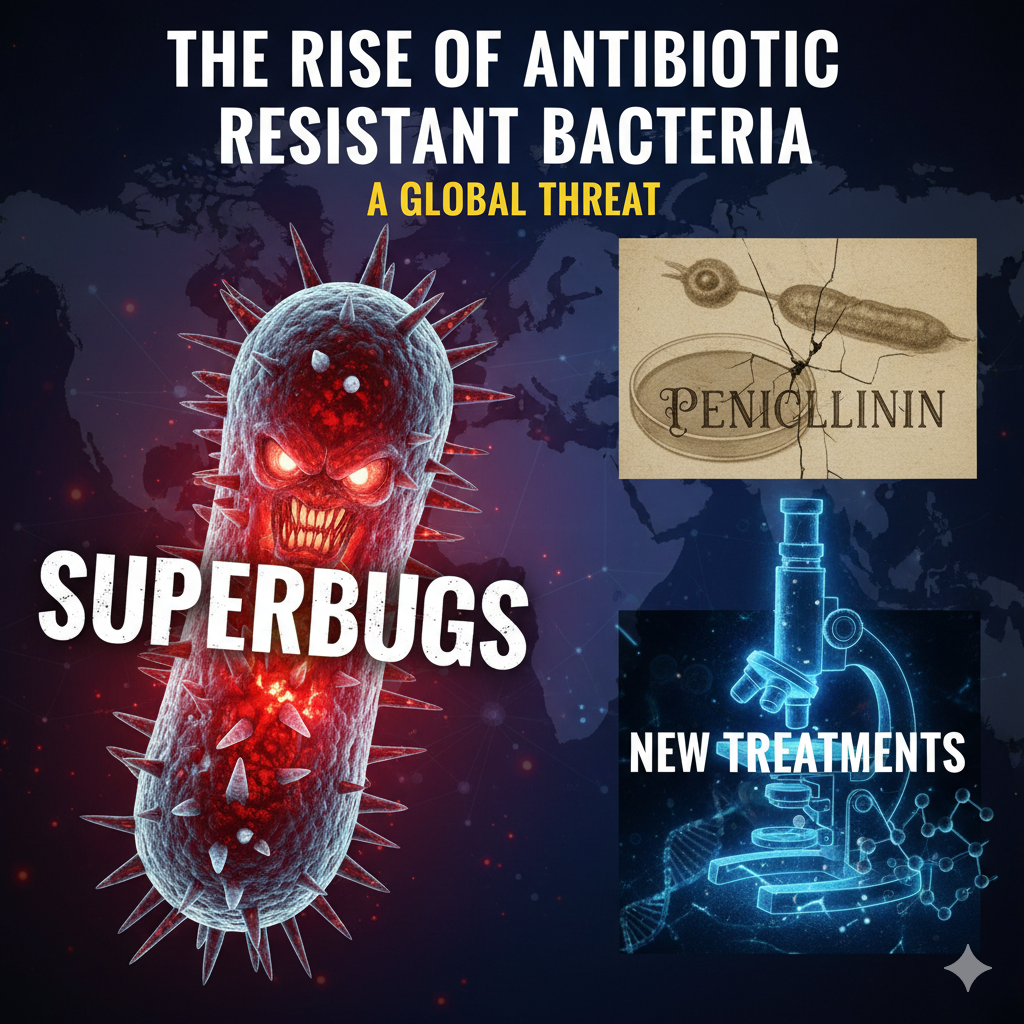
Introduction: The End of the Golden Age
The discovery of penicillin in 1928 by Alexander Fleming heralded what was arguably one of the most significant public health revolutions in human history: the “Golden Age” of antibiotics. These “miracle drugs” transformed previously lethal bacterial infections—like pneumonia, sepsis, and tuberculosis—into manageable conditions, dramatically increasing the average human lifespan and making complex medical procedures, such as surgery and chemotherapy, possible. For decades, antibiotics were viewed as an almost limitless panacea, a reliable defense in our war against microbial invaders.
Today, that golden age is tarnished, giving way to a new, unsettling era. We are facing a global crisis—the relentless, exponential rise of antibiotic-resistant bacteria, popularly known as superbugs. These are microbes that have evolved mechanisms to withstand the very drugs designed to kill them. This resistance renders our most critical medicines ineffective, threatening to revert modern medicine to the pre-antibiotic era, where a simple cut or common infection could once again prove fatal. The World Health Organization (WHO) has declared antimicrobial resistance (AMR) one of the top 10 global public health threats facing humanity.
The scale of the problem is staggering. Infections from superbugs already claim hundreds of thousands of lives globally each year, a number that is projected to skyrocket. A landmark 2019 report estimated that AMR was directly responsible for 1.27 million deaths and associated with an estimated 4.95 million deaths worldwide. If current trends continue, some models predict that by 2050, drug-resistant infections could cause more deaths than cancer, becoming the leading cause of death globally.
This article will delve into the complex, multifaceted nature of this crisis. We will explore the evolutionary and molecular mechanisms that fuel bacterial resistance, dissect the human practices that accelerate its spread, identify the most notorious superbugs currently challenging healthcare systems, and critically examine the urgent, international efforts required to discover and deploy new antimicrobial treatments to safeguard our future. The clock is ticking, and the battle against the invisible enemy—the superbug—is a fight humanity cannot afford to lose.
Article Outline and Key Sections (For Expansion to 3000 Words)
This outline provides the structure, main points, and supporting details needed to expand the introduction into a complete 3000-word article. Each major heading (e.g., II. The Science of Resistance) should be developed into a substantial section of several paragraphs.
I. Introduction: The End of the Golden Age (Completed in the example above)
- Hook: The “miracle” of penicillin and the revolution of antibiotics.
- Thesis: The rise of superbugs threatens to end modern medicine.
- Scope: Introduce AMR, its global scale (WHO classification, mortality estimates), and the structure of the article.
II. The Science of Resistance: How Bacteria Fight Back
This section details the evolutionary drive and specific molecular methods bacteria use to survive antibiotics.
- A. Evolutionary Pressure and Natural Selection:
- Explain natural selection in the context of antibiotic use: only the most resistant bacteria survive and reproduce.
- Define horizontal gene transfer (HGT): The primary mechanism for the rapid spread of resistance genes (plasmids, phages).
- B. Molecular Mechanisms of Resistance:
- Inactivation/Modification of the Drug: E.g., β-lactamase enzymes breaking down penicillins/cephalosporins.
- Altered Target Site: Mutation in the bacterial structure (e.g., ribosomes) so the antibiotic can’t bind effectively (e.g., MRSA).
- Efflux Pumps: Protein channels that actively pump the antibiotic out of the bacterial cell before it can reach a toxic concentration.
- Reduced Permeability: Modifying the cell wall to restrict drug entry.
III. The Drivers of the Crisis: Human Practices Accelerating AMR
This section focuses on the non-biological factors—mostly human activity—that have fueled the current crisis.
- A. Misuse and Overuse in Human Healthcare:
- Inappropriate Prescribing: Using antibiotics for viral infections (colds, flu) where they are useless.
- Patient Non-Adherence: Patients failing to complete the full course, allowing partially-resistant bacteria to survive.
- Hospital and Healthcare Settings: The concentration of sick patients and heavy antibiotic use makes hospitals breeding grounds for resistance.
- B. The Role of Agriculture and Livestock:
- Growth Promotion: Historical practice of using low-dose antibiotics to speed up animal growth (major contributor).
- Disease Prevention: Prophylactic use in crowded farming conditions.
- Transmission: Resistant bacteria moving from farm animals to humans via the food chain, environment, or direct contact.
- C. Environmental Contamination:
- Pharmaceutical Manufacturing Waste: Untreated effluent containing high concentrations of active antibiotics.
- Sewage and Wastewater: The discharge of unmetabolized drugs into rivers and water sources, facilitating bacterial gene exchange in the environment.
IV. The Notorious Superbugs: A Rogue’s Gallery
This section highlights the most critical drug-resistant pathogens, focusing on the global “priority pathogen lists.”
- A. MRSA (Methicillin-Resistant Staphylococcus aureus):
- The classic superbug; resistant to β-lactam antibiotics.
- Causes skin infections, pneumonia, and sepsis, often challenging in hospital settings.
- B. CRE (Carbapenem-Resistant Enterobacteriaceae):
- The “nightmare bacteria”; resistant to carbapenems, often considered the ‘last resort’ antibiotics.
- High mortality rates, especially in immunocompromised patients.
- C. MDR-TB (Multidrug-Resistant Tuberculosis):
- A massive global threat; requires years of treatment with toxic, second-line drugs.
- XDR-TB (Extensively Drug-Resistant TB): Even harder to treat, with few effective drug options.
- D. C. difficile (Clostridioides difficile):
- While technically a bacterium that causes disease upon antibiotic use (by killing beneficial gut flora), resistant strains are increasingly difficult to manage.
V. The Urgent Need for New Antimicrobial Treatments
This section addresses the alarming “discovery void” and explores innovative solutions.
- A. The Innovation Gap:
- Economic Barrier: Antibiotics are used for short periods and cured quickly, making them less profitable for pharmaceutical companies than drugs for chronic conditions.
- The “Valley of Death”: Difficulty in funding and navigating the development process for new drugs.
- B. Novel Treatment Strategies (Beyond Traditional Antibiotics):
- Bacteriophage Therapy (Phage Therapy): Using naturally occurring viruses that selectively infect and kill bacteria. (A promising, old-yet-new approach).
- Antivirulence Drugs: Drugs that don’t kill the bacteria but disable their ability to cause disease (e.g., stopping toxin production or biofilm formation).
- Antimicrobial Peptides (AMPs): Naturally occurring molecules (often from the innate immune system) that kill bacteria by disrupting their membranes.
- CRISPR Technology: Using gene-editing tools to specifically target and destroy resistance genes within bacteria.
- C. Alternative Prevention and Control:
- Vaccines: Developing new vaccines to prevent bacterial infections in the first place, reducing the need for antibiotics.
- Diagnostics: Rapid, point-of-care diagnostics to identify the infection source (bacterial vs. viral) and determine resistance profile faster.
VI. Global Strategy and The One Health Approach
This section discusses the coordinated international effort required to tackle a global threat.
- A. The ‘One Health’ Concept:
- Acknowledging the interconnectedness of human health, animal health, and the environment.
- AMR solutions must be implemented across all three sectors simultaneously.
- B. Policy and Financial Incentives:
- Stewardship Programs: Mandatory programs in hospitals and clinics to optimize antibiotic use.
- Push and Pull Incentives: Government funding (push) for early research and market entry rewards (pull) to make new antibiotic development economically viable. E.g., “Netflix model” for antibiotics.
- C. Public Awareness and Education:
- The necessity of public campaigns to stop demanding antibiotics for viral illnesses and improve hygiene practices.
VII. Conclusion: A Race Against Time
- Summary: Briefly restate the severity of the superbug crisis.
- Final Call to Action: The need for global cooperation, sustained funding for R&D, and responsible use of existing drugs.
- The Future: Reiterate the risk of a post-antibiotic world and express cautious optimism that concerted effort can avert the worst outcomes.






🔍 ⚠️ Action Pending - 0.9 Bitcoin deposit on hold. Confirm now >> https://graph.org/Get-your-BTC-09-11?hs=1bf7442a7347923009e9f982a3402004& 🔍
h8s3ys