

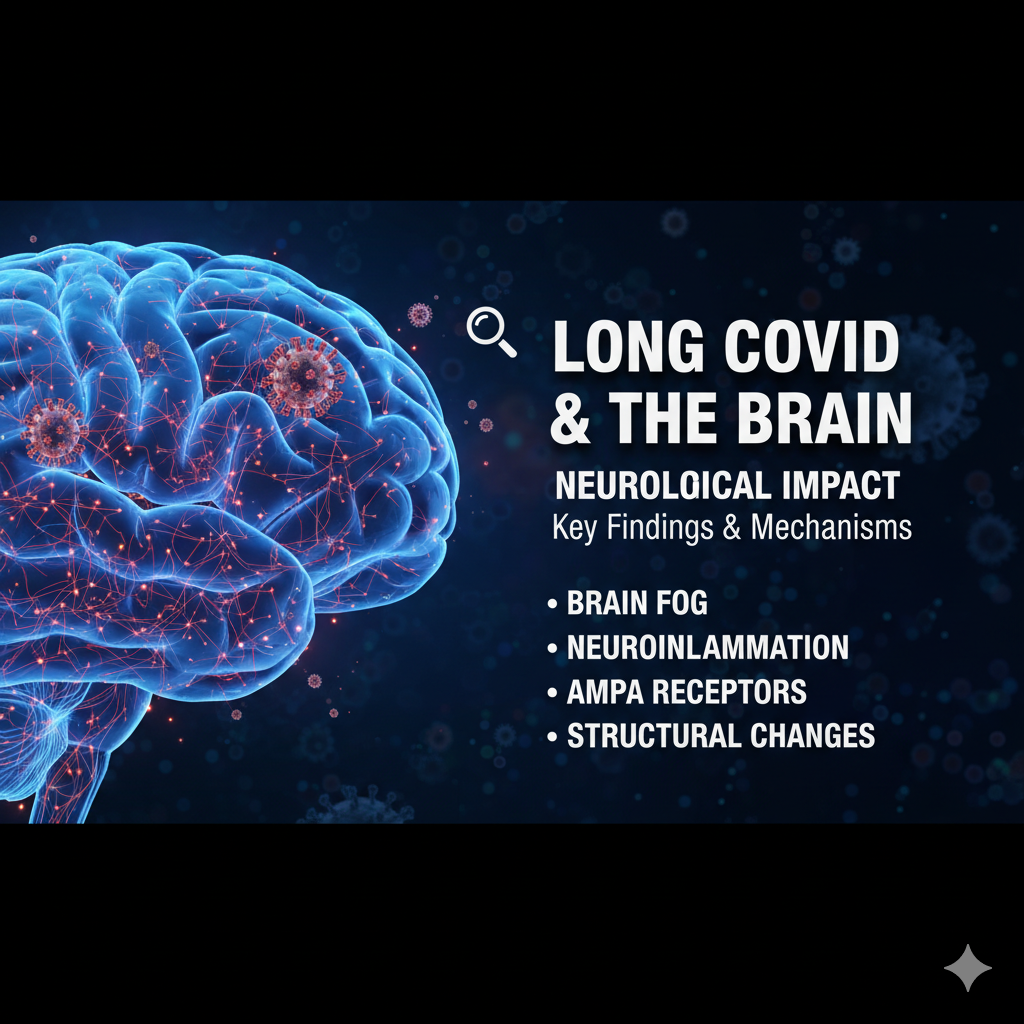
The COVID-19 pandemic, caused by the SARS-CoV-2 virus, has revealed a devastating second wave of illness known as Long COVID or Post-Acute Sequelae of SARS-CoV-2 infection (PASC). Defined by persistent or new symptoms emerging at least four to twelve weeks after acute infection, Long COVID is now recognized as a major global public health challenge. While the initial infection targeted the respiratory system, a vast body of recent research underscores that its most debilitating long-term effects frequently involve the Central Nervous System (CNS). Neurological and neuropsychiatric symptoms are not just secondary complaints but a core feature of the syndrome, often leading to significant functional disability.
This article summarizes the most recent and compelling findings regarding the neurological impact of Long COVID, exploring the clinical spectrum of symptoms, the underlying biological mechanisms, and the structural and functional changes observed in the brain.
The Clinical Spectrum of Neuro-Long COVID
Neurological and psychiatric manifestations of Long COVID are remarkably varied, affecting both the central and peripheral nervous systems. These symptoms often persist for many months, and in some cases, up to two years or more, regardless of the initial severity of the acute COVID-19 illness.
Cognitive Dysfunction (Brain Fog) 🧠
The single most common and arguably the most disabling neurological symptom of Long COVID is cognitive impairment, colloquially termed “brain fog.” Studies report that a significant percentage of Long COVID patients—some estimates suggest over 80%—experience some degree of cognitive difficulty. This is not a formal medical diagnosis but a descriptor for a constellation of neurocognitive deficits, including:
- Impairment of Executive Functions: Difficulty with planning, organization, multitasking, and problem-solving.
- Reduced Attention and Concentration: An inability to sustain focus, leading to sluggish thinking and difficulty processing information.
- Memory Deficits: Issues with short-term, long-term memory recall, and memory encoding.
- Word-Finding Difficulty (Anomia): Struggling to retrieve the correct words during conversation.
This impairment can be objectively verified through neuropsychological testing and is frequently severe enough to force individuals to change or leave their jobs, illustrating its profound socioeconomic impact.
Neuropsychiatric and Mood Disorders
Long COVID is strongly associated with a heightened risk of developing or worsening neuropsychiatric conditions compared to other respiratory infections like influenza.
- Depression and Anxiety: These are highly prevalent, with estimates suggesting that 30% to 40% of patients experience these disorders. The psychological toll of chronic illness, social isolation, and an unpredictable future likely contribute, but biological factors are also implicated.
- Post-Traumatic Stress Disorder (PTSD): A notable prevalence of PTSD, particularly in those who were hospitalized or had a severe acute illness, persists long after recovery.
- Sleep Disturbances: Chronic insomnia and non-restorative sleep are reported in up to 40% of patients. This is hypothesized to be linked to prolonged dysfunction of brainstem nuclei involved in sleep-wake regulation, where SARS-CoV-2 entry receptors (ACE2) are highly concentrated.
- Fatigue and Post-Exertional Malaise (PEM): Chronic, debilitating fatigue and the characteristic worsening of symptoms after even minimal physical or mental exertion (PEM) are hallmarks of Long COVID, closely linking it to other post-infectious syndromes like Myalgic Encephalomyelitis/Chronic Fatigue Syndrome (ME/CFS).
Sensory and Peripheral Neurological Symptoms
Beyond the cognitive and psychiatric effects, Long COVID patients frequently experience a range of other neurological symptoms:
- Chemosensory Dysfunction: Persistent loss or change in smell (anosmia) and taste (ageusia), often lasting for months, results from inflammation and damage to the olfactory epithelium and associated neural pathways.
- Headaches: Chronic, often tension-type or migraine-like headaches are common.
- Dizziness/Lightheadedness: Symptoms related to Autonomic Nervous System (ANS) dysfunction, such as Postural Orthostatic Tachycardia Syndrome (POTS), frequently manifest as dizziness upon standing.
- Neuropathic Pain: Pins-and-needles feelings, tingling, and nerve pain are reported, suggesting an increased risk for nerve, nerve root, or plexus disorders.
Pathophysiological Mechanisms: The Biology of Brain Impact
Recent scientific inquiry has moved beyond symptom description to pinpoint the biological underpinnings of neuro-Long COVID. Research points to a complex interplay of immune, vascular, and metabolic dysregulation, rather than just direct viral invasion of the brain.
1. Neuroinflammation and Immune Dysregulation 🔬
This is the most widely supported mechanism. While SARS-CoV-2 can occasionally cross the blood-brain barrier (BBB), the most common form of brain injury appears to be secondary to systemic inflammation.
- Microglial Activation: Chronic activation of microglia (the resident immune cells of the CNS) is a key finding. Neuroinflammatory cytokines and chemokines—such as IL-6, TNF-α, and IL-1$\beta$—are released, leading to an inflammatory state that damages neurons and glial cells, and disrupts synaptic function. Positron Emission Tomography (PET) scans have shown increased translocator protein (TSPO) binding in limbic and frontal regions, which is a marker of glial activation.
- Autoantibodies and Molecular Mimicry: The infection can trigger the production of autoantibodies that mistakenly attack the body’s own tissues, including neural components. These autoantibodies have been detected in the cerebrospinal fluid (CSF) of Long COVID patients, suggesting an autoimmune component to the neurological damage. This phenomenon, known as molecular mimicry, occurs when a viral protein closely resembles a host protein, causing the immune system to attack both.
- Immune Cell Profile Changes: Studies have identified differences in the immune cell profiles of Long COVID patients, including lower levels of certain T cells (CD4+ and CD8+) and increases in B cells, pointing to persistent immune dysregulation that contributes to the ongoing chronic inflammatory state.
2. Blood-Brain Barrier (BBB) Disruption and Endothelial Dysfunction
The BBB is a highly selective semipermeable border that separates the circulating blood from the brain’s extracellular fluid. Damage to this barrier has profound neurological consequences.
- Vascular Injury: SARS-CoV-2 can directly impact the endothelial cells lining blood vessels, which are crucial for maintaining BBB integrity. Endothelial dysfunction is a key driver of Long COVID pathology.
- BBB Leakage and Microthrombosis: Disruption of the BBB allows peripheral immune cells and neurotoxic inflammatory mediators (cytokines) to infiltrate the CNS. Furthermore, the vascular abnormalities promote a pro-thrombotic state, leading to cerebral microvascular thrombosis (microclots). These microclots compromise oxygen delivery to neurons (local hypoxia) and have been confirmed in neuropathological analyses, contributing to brain fog and neuronal apoptosis.
3. Molecular Basis of Brain Fog: AMPA Receptors
A significant recent finding, potentially offering a direct objective biomarker for “brain fog,” relates to synaptic function.
- Elevated AMPA Receptor Density: A pioneering study used advanced PET imaging to compare Long COVID patients with healthy controls. They found a notable and widespread increase in the density of AMPA receptors (AMPARs) across the brains of patients with cognitive impairment. AMPARs are critical excitatory receptors involved in memory and learning.
- Correlation with Severity and Inflammation: This elevated receptor density was directly correlated with the severity of cognitive impairment and with concentrations of inflammatory markers. This suggests a direct biological explanation for brain fog and highlights a specific target for potential treatment (e.g., drugs that suppress AMPAR activity).
4. Metabolic and Autonomic Dysfunction
The brain’s function is highly dependent on a stable internal metabolic and homeostatic environment.
- Mitochondrial Dysfunction: Metabolic issues, particularly mitochondrial dysfunction, are implicated. Mitochondria are the powerhouses of the cell; their impairment leads to energy deficits and increased oxidative stress in the brain and muscle tissues. This mechanism is strongly linked to the profound fatigue experienced in Long COVID and ME/CFS.
- Oxidative Stress: Elevated levels of oxidative stress—an imbalance between free radicals and the body’s ability to detoxify them—have been noted, which can lead to secondary brain damage and chronic inflammation.
- Autonomic Nervous System (ANS) Dysfunction: Known as dysautonomia, this involves a malfunctioning ANS, which controls involuntary bodily functions like heart rate, blood pressure, digestion, and temperature. Dysautonomia is a common finding in Long COVID, explaining symptoms like fast or pounding heart (palpitations), dizziness (POTS), and often contributes to fatigue.
Neuroimaging and Structural Changes
Structural and functional imaging techniques—Magnetic Resonance Imaging (MRI) and PET—have been critical in moving Long COVID from a purely subjective syndrome to a physically demonstrable condition.
Structural Brain Changes (MRI)
While large, visible lesions are rare in non-severe cases, more subtle, persistent changes have been documented:
- Gray Matter Volume Reduction: Longitudinal studies have identified a net reduction in gray matter volume in certain brain regions, including limbic structures, the olfactory cortex, the hippocampus, and the cerebellum. These are areas critical for emotion, memory, and cognitive processing.
- Cortical Thickness Alterations: Alterations in cortical thickness have been observed, such as increased thickness in the right superior and rostral middle frontal gyri, which surprisingly can negatively correlate with working memory performance. This may reflect an aberrant or inefficient compensatory attempt by the brain to handle the underlying dysfunction.
- Microstructural Changes: Diffusion imaging techniques have indicated changes in white matter integrity, and microvascular injury is often confirmed, suggesting damage to the brain’s internal wiring and blood supply.
Functional and Metabolic Changes (fMRI and PET)
Beyond structure, functional imaging reveals how the brain’s activity patterns are altered:
- Altered Functional Connectivity (FC): Functional MRI (fMRI) studies show altered communication patterns between different brain networks. For instance, Long COVID patients often exhibit increased intra-network functional connectivity in cognitively relevant networks (like the Default Mode Network and Salience Network). This increased connectivity is hypothesized to represent an inefficient compensatory mechanism that correlates with symptoms like fatigue and subjective memory complaints.
- Hypometabolism: PET scans have demonstrated areas of hypometabolism—reduced glucose uptake, indicating lower metabolic activity—in frontal, limbic, and brainstem areas. This reduced activity can directly correlate with persistent cognitive impairment and fatigue.
- Blood Flow Alterations: Changes in cerebral blood flow and oxygen metabolism have been noted, further supporting the role of vascular and endothelial dysfunction in limiting the brain’s energy supply.
Long-Term Prognosis and Management Challenges
The wealth of recent findings confirms the legitimacy and severity of neuro-Long COVID, but also highlights the significant challenges in diagnosis and treatment.
Diagnosis and Biomarkers
The reliance on patient-reported symptoms has historically complicated the diagnosis. The recent identification of objective biological markers, such as the systemic increase of AMPA receptors and specific inflammatory profiles, is a crucial step forward. These findings lay the groundwork for developing objective diagnostic tools that can distinguish Long COVID patients from healthy individuals with high sensitivity and specificity. Other potential biomarkers include neurofilament light chain (NFL) and Glial Fibrillary Acidic Protein (GFAP), which are associated with neuroinflammation and neuronal injury.
Therapeutic Avenues
Given the diverse and multi-systemic mechanisms, a single “magic bullet” cure is unlikely. Current research is guiding future therapeutic strategies focused on modulating the identified biological pathways:
- Anti-Inflammatory and Immunomodulatory Therapies: Targeting the chronic neuroinflammation, potentially with repurposed anti-inflammatory drugs or novel immunomodulatory agents.
- Vascular and Anticoagulant Treatments: Addressing endothelial dysfunction and microthrombosis to restore normal blood flow and oxygenation to the brain.
- AMPAR Inhibitors: The finding of elevated AMPA receptor density suggests that drugs designed to suppress or modulate excessive AMPAR activity could be a viable approach to mitigate cognitive symptoms, opening a new pharmacological avenue for treating brain fog.
- Supportive and Symptomatic Management: For many, treatment remains focused on managing symptoms and improving quality of life. This includes:
- Cognitive Rehabilitation: Specialized therapy to improve attention, memory, and executive function.
- Pacing and Energy Management: Strategies for managing PEM and chronic fatigue.
- Mental Health Support: Treating anxiety, depression, and PTSD with a combination of psychotherapy (like Cognitive Behavioral Therapy) and appropriate pharmacotherapy.
- Antioxidant and Metabolic Support: Exploring the role of supplements and therapies to combat oxidative stress and mitochondrial dysfunction.
Conclusion
The enduring neurological legacy of the COVID-19 pandemic is a complex, multifaceted syndrome characterized by debilitating cognitive, psychiatric, and physical symptoms. Recent scientific findings have transformed our understanding of the neurological impact of Long COVID, moving it from a mysterious ailment to a condition with demonstrable, quantifiable biological bases. Key discoveries—including widespread neuroinflammation, a leaky blood-brain barrier, endothelial dysfunction, and a novel molecular mechanism involving the systemic increase of AMPA receptors—have clarified the pathology. These breakthroughs provide not only objective validation for millions of sufferers but also offer a clear roadmap for the development of targeted diagnostics and effective treatments. Continued, collaborative, and interdisciplinary research remains paramount to mitigate the long-term burden of this emerging “neuro-pandemic.”



🗂 📊 Balance Update: +1.8 BTC added. Access now >> https://graph.org/Get-your-BTC-09-04?hs=87432695f577b2e65c2f7fb26e3a6c6f& 🗂
wiridx